
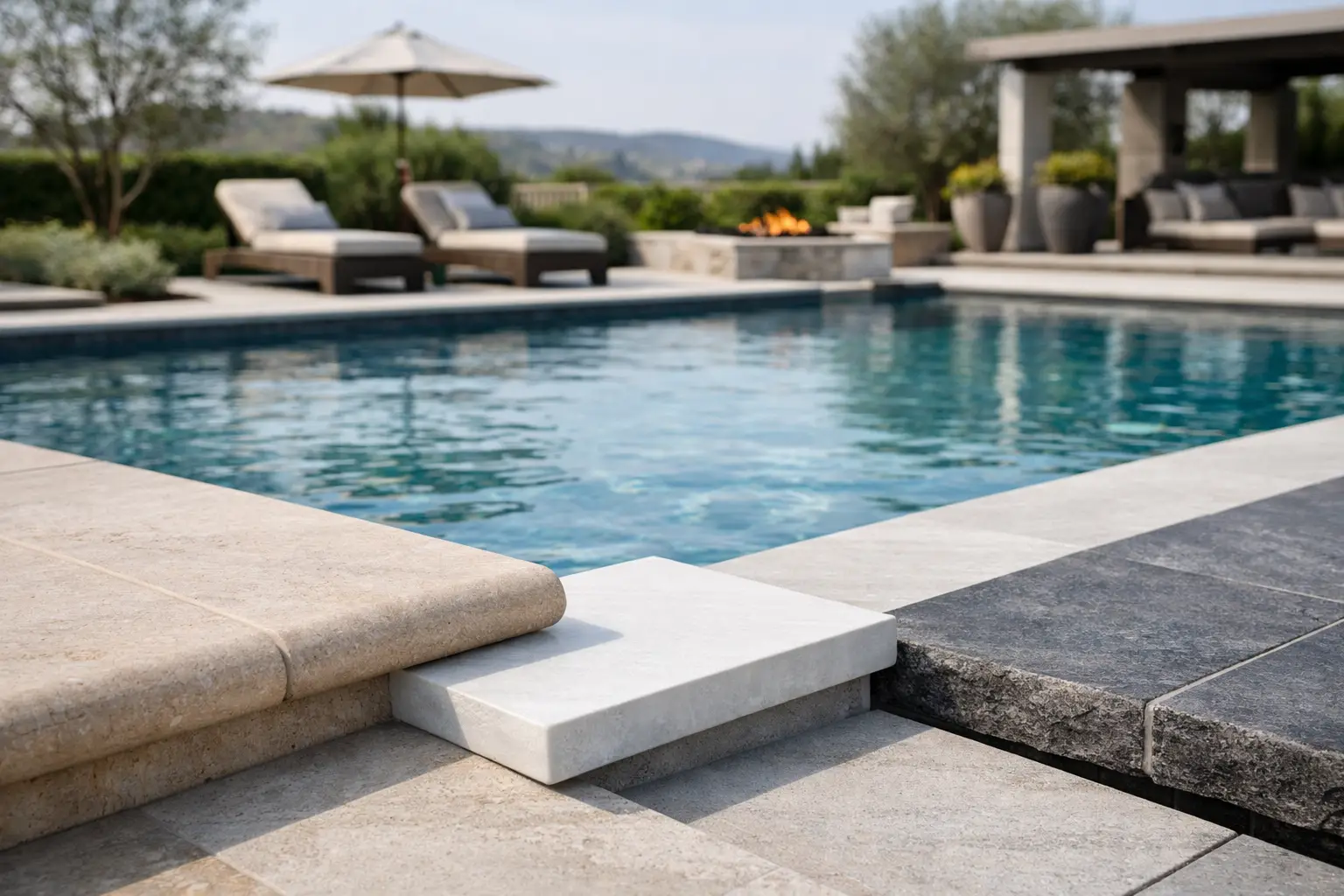
Pool Coping Options That Define a Luxury Backyard
Estimated reading time: 7 minutes
The edge of your pool does more than finish the waterline. It is where bare feet land, where guests sit with a drink, where swimmers enter and exit, and where the pool visually meets the deck. That is why choosing the right pool coping options can make the difference between a backyard that feels pieced together and one that feels like a private resort.
For Southern California homeowners, coping must work hard. It needs to complement the architecture, stand up to sun and pool chemicals, provide dependable traction, and look exceptional from every angle. The best selection is not simply the most expensive material. It is the material, profile, color, and installation approach that fit the entire outdoor design.
What Pool Coping Actually Does
Pool coping is the cap or edge treatment installed around the perimeter of a swimming pool. It creates a finished transition between the pool shell and the surrounding deck while helping direct splash-out water away from the pool structure. Properly detailed coping also protects the pool edge and gives the deck a clean, intentional boundary.
From a design standpoint, coping is a small surface with an outsized impact. A pale stone edge can make a pool feel airy and coastal. A substantial drop-face coping can give a rectangular pool a tailored, architectural presence. A continuous cantilevered edge creates a cleaner, more contemporary look.
This is also a safety decision. The coping should feel comfortable underfoot, offer an appropriate amount of grip when wet, and avoid sharp edges where children and guests move around the water. A luxury result should never require a trade-off in day-to-day usability.
Pool Coping Options by Material
Natural stone for a custom, resort-style finish
Natural stone remains a leading choice for homeowners who want a high-end outdoor environment with real character. Travertine, limestone, sandstone, and select granite varieties each bring a distinct color range, texture, and visual weight to the pool perimeter.
Travertine is especially popular in warm-climate backyards because lighter tones tend to stay more comfortable in direct sun, and its naturally textured surface can provide useful traction. It pairs naturally with paver patios, outdoor kitchens, and Mediterranean, transitional, or modern resort designs. Because stone is a natural material, variation is part of the appeal. It also means samples and layout planning matter. A strong installation accounts for color movement, veining, thickness, and edge consistency before the first piece is set.
Limestone offers a quieter, more refined appearance, often with softer neutral tones that suit elevated contemporary landscapes. Some limestone choices need more careful consideration around water exposure and maintenance, so the exact stone should be selected for the conditions of the project rather than solely for its showroom appearance.
Porcelain coping for clean lines and color control
Porcelain coping is a smart option for homeowners seeking a crisp, uniform look with low porosity. It is available in a wide range of stone-inspired, concrete-inspired, and contemporary finishes, making it easier to coordinate the pool edge with large-format patio surfaces.
The strength of porcelain is consistency. It can deliver a precise color story and a sleek visual rhythm around geometric pools. Quality matters here: the selected product should be rated for exterior use, have an appropriate wet slip resistance, and be installed with the proper substrate preparation and setting materials. A beautiful porcelain edge can underperform if the installation details are treated as an afterthought.
Precast concrete coping for versatile design
Precast concrete coping gives homeowners extensive flexibility in shape, color, and profile. It can work beautifully around traditional pools, contemporary pools, and curved freeform designs where a custom stone layout may be less practical.
Concrete coping can be finished to resemble natural stone or created in a smoother, more streamlined style. It is not maintenance-free, and its appearance depends heavily on mix quality, finishing, and sealing. When designed and installed correctly, it delivers a substantial, tailored edge without distracting from the rest of the backyard.
Paver coping for coordinated outdoor spaces
When the pool deck uses pavers, matching or complementary paver coping can create a highly unified result. This approach works particularly well when the goal is to make the patio, walkways, spa surround, and pool edge read as one complete outdoor environment.
Not every paver is suitable for a pool edge. The coping needs the right thickness, edge treatment, and durability for its location. The layout must also respect expansion, movement, and drainage. A coordinated paver design looks effortless only when those structural details are handled with precision.
Choose the Right Coping Profile
Material gets most of the attention, but the profile determines how the coping feels and how strongly it shapes the pool’s style. A rounded bullnose profile offers a softer, classic edge that is comfortable for families and works well with traditional or freeform pool designs.
A square-edge profile feels more modern and architectural. It is a natural fit for rectilinear pools, sharp deck lines, and minimalist outdoor spaces. The edge should still be eased enough to be comfortable and safe, rather than left aggressively sharp for the sake of appearance.
Cantilevered coping extends the deck material directly over the pool edge, creating a continuous plane with little visual interruption. This is a powerful choice for contemporary backyards, especially when the deck surface is a premium concrete finish, porcelain, or paver system designed for the detail. It requires experienced forming, drainage planning, and expansion-joint placement to perform well over time.
Drop-face coping uses a visible vertical edge at the waterline. It adds depth and visual substance, making the pool appear more finished and intentional. This profile can be especially striking when paired with tile, darker interior finishes, or a raised spa.
Match the Coping to the Deck, Waterline Tile, and Home
Coping should not be selected in isolation. The most polished pool renovations begin with a complete material palette that considers the home exterior, pool finish, waterline tile, deck surface, landscape elements, and any nearby fire feature or outdoor kitchen.
Contrast can be effective. Cream-colored stone coping around a deep blue pool finish creates a bright, resort-inspired frame. A charcoal porcelain coping paired with pale decking can feel dramatic and modern. But too many competing colors or patterns can shrink the visual impact of the pool itself.
For a more expansive effect, choose coping that relates closely to the deck color while adding a subtle texture or tonal shift. This lets the eye move smoothly across the patio toward the water. For a stronger focal point, use coping as the intentional border between the deck and pool, with enough contrast to define the geometry.
Samples should be reviewed outdoors, not only under showroom lighting. Southern California sunlight changes how undertones appear. A gray that looks cool indoors may read warm outside, while a beige stone can appear much lighter beside blue water.
Performance Details That Protect the Investment
A premium pool edge is built on more than attractive materials. Drainage is one of the most important considerations. Water should move away from the pool structure and surrounding hardscape in a controlled manner, preventing pooling, staining, and long-term movement issues.
Expansion joints also deserve attention. Pool shells, coping, and deck surfaces can move differently with temperature changes and settling. Proper joint placement and flexible sealants allow those materials to move without creating unnecessary cracking or separation.
Slip resistance should be evaluated honestly. Highly polished surfaces may look impressive in a sample display but can be a poor choice around active pools. Texture, finish, slope, and the way the material behaves when wet all matter. Families with children, frequent entertaining plans, and pet-friendly yards should prioritize a surface that feels secure under bare feet.
Maintenance varies by material. Some natural stone may benefit from periodic sealing and prompt cleanup of spills. Porcelain generally needs less ongoing care but still requires attention to grout or joints. Concrete may need resealing over time. The right question is not which option needs zero maintenance, because none do. It is which maintenance level fits the way you plan to use the backyard.
When Replacing Coping During a Pool Remodel Makes Sense
Coping replacement is often the right move when the existing edge is cracked, loose, stained beyond practical repair, uncomfortable underfoot, or visually disconnected from a new deck design. It is also worth considering when upgrading waterline tile, resurfacing the pool, adding a spa, or changing the patio material.
Trying to preserve outdated coping while making major changes around it can limit the final design. A new pool finish and elegant porcelain deck will not reach their full potential if an old, mismatched edge remains between them. On the other hand, if the existing coping is sound and genuinely works with the new palette, preserving it may be the more efficient design decision.
A professional design-and-build process evaluates the entire pool environment before recommending a direction. At Build Up Remodeling, that means looking beyond a single material sample to plan the pool edge, deck elevations, drainage, finishes, and circulation as one coordinated outdoor space.
The right coping should make every swim, gathering, and quiet evening by the water feel considered. Start with the way you want the backyard to look and function, then choose the edge detail that makes that vision feel complete.
Get Started
Send us a brief message and let’s work together.
"*" indicates required fields
We try our best to reach out in less then 24 Hours.